
At the MILA seminar “AI in HR: from recruitment to process automation,” experts shared practical experiences of using AI in developing employee skills, preserving organizational knowledge, and improving daily processes. The key takeaway: start with a specific need and small experiments, involving employees and testing results.
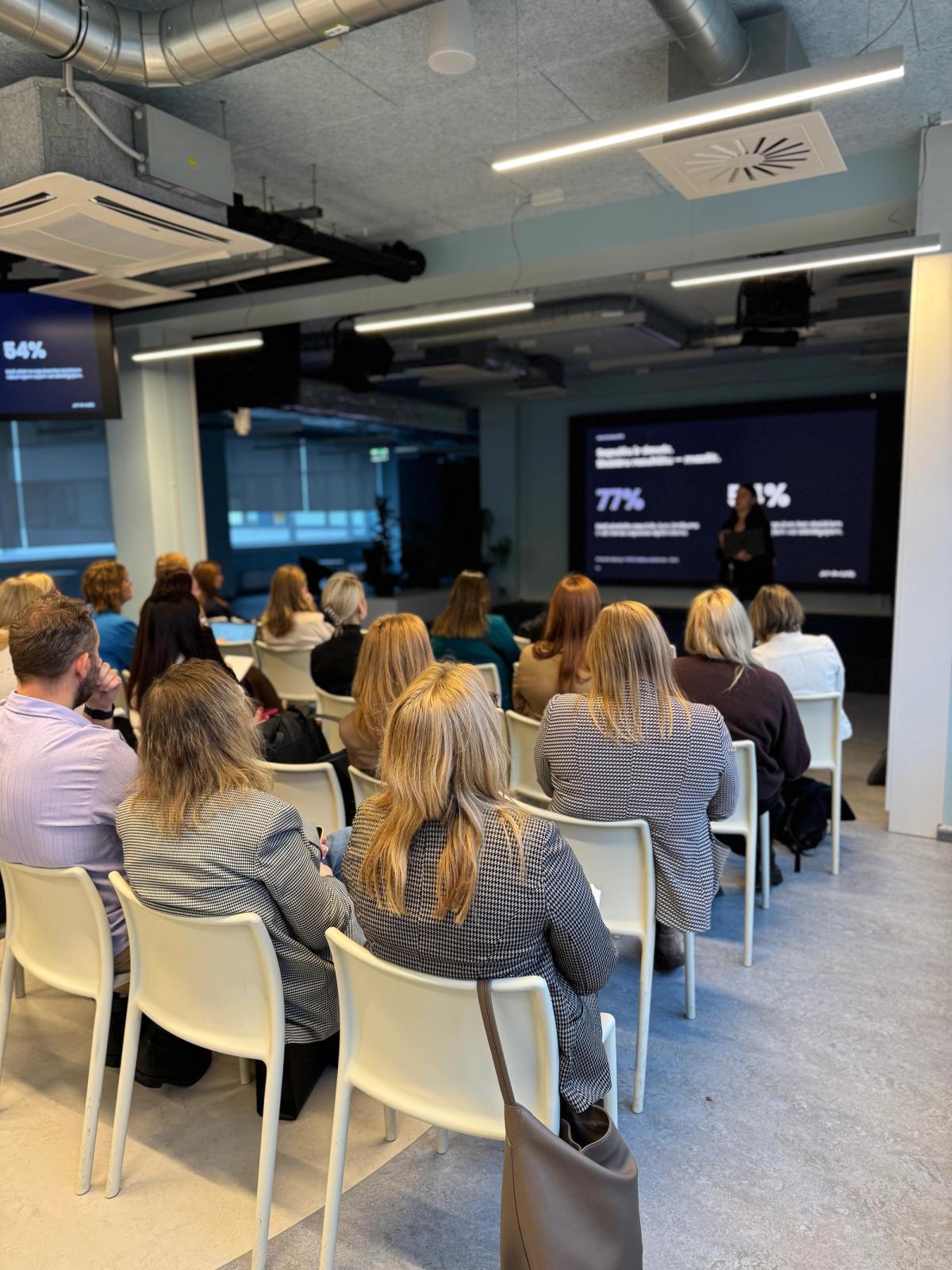
On November 23, the MILA seminar “AI in HR: from Recruitment to Process Automation” took place at the Riga Technical University. Experts shared their experience in using artificial intelligence to develop employees’ skills, preserve organizational knowledge, and improve HR processes. In the second part of the event, participants discussed their organizations’ challenges in individual consultations with experts.
How to move from individual testing of AI tools to their thoughtful use in a team? This question united several presentations at the seminar. The experience of the speakers revealed that, in addition to the possibilities of technology, a clear work process, the involvement of management and people who are able to appreciate the result are of crucial importance.
AI Academy representativeJānis Kreiliscalled for the introduction of AI to start with small experiments to test a specific assumption. Before investing in developing a large-scale solution, it is worth finding out whether the technology can perform the more difficult or uncertain part of the task well enough.
“When I think in terms of this experimental idea, my goal is knowledge. […] If something doesn't work, I get the knowledge that something doesn't work. That's still a gain, right?”Jānis Kreilis, AI Academy
This approach also helps to change the attitude towards experiments: a result that does not meet the initial expectations provides information for the next decision. The organisation can refine the task, change the approach or give up a solution that is not suitable for the specific need in time.
A valuable insight for organizations: employees need both access to AI tools and time to try them out and check the results.The call to experiment will be hard to implement if it becomes an additional duty on top of a full day's work.
Seminar introductionEvaldas Urtanas, Chairman of the Board of MILA, demonstrated the possibilities of AI by connecting different sources of information and tools in a single working environment. Such connections can help search for information, prepare reports, and perform several sequential tasks.
At the same time, he drew attention to the need to critically evaluate the answers provided by AI. A good result in one task does not mean that the tool will be equally reliable in another.
Betty Dean-Muižniece of ANIMAScontinued the theme of knowledge that often remains in the experience of employees, conversations and meetings in organizations. Together with the AI instructions, orskills, templates and tested examples can help make working methods available to a wider team.
And meeting transcripts and a well-curated knowledge base can help preserve the rationale behind decisions and find the information you need later. It’s important to maintain a link to the source of information and distinguish an AI-generated suggestion from a human-approved decision.
Madara Grīnberga and Kristaps Kļava from Scandiwebpresented the company's solution Fairwind and experience in developing customer communication skills.
Their story focused on a challenge familiar to many organizations: the knowledge gained in training doesn't always translate into everyday habits. AI can help support this transition by providing suggestions in specific work situations and regular feedback on progress.
For this approach to be useful, the organization must first define clear principles of good communication. The purpose of the evaluation should be to develop skills and support the employee.
Uldis Karlovs-Karlovskis from MoonMoonstressed the difference between individual use of AI and its use at team level. The active engagement of individual employees with AI does not automatically lead to an increase in overall productivity.
The next step is a shared working environment, agreement on the principles of use and learning by solving real company tasks. As it develops from a personal assistant to team-based solutions, the need for technical support and management also increases.
Guntis Kalniņš from AI Master Labcalled for the introduction of AI to be seen as a process of organizational change. The choice of technology is only one part of it - alongside it is necessary to think about management goals, employee competencies, data and the culture of cooperation.
HR plays a key role in this process as job roles, required skills and the way teams work together are changing. A clear vision of the desired outcome and ownership of the implementation helps to connect the possibilities of technology with the needs of the organization.
Agnese Jaunošāne from AjelixThe introduction of an MI agent was compared to hiring a new employee: a job description, appropriate access, and a probationary period were required.
She highlighted three practical applications in HR management: answering employee questions about internal company procedures, analyzing open-ended survey responses, and maintaining a consistent HR communication style. Before wider use, agent responses need to be tested and situations requiring human intervention identified.
The second part of the event was dedicated to individual consultations with experts, allowing participants to move from discussing trends together to specific questions about using AI in their organisation.
The examples presented at the seminar showed that Latvia has both the competence to develop AI solutions and practical experience in implementing them. The next task for organizations is to evaluate how to incorporate these opportunities into existing work processes and ensure that the chosen solutions complement each other.
The common thread: start with a clearly defined need, test the solution on a small scale, and keep human responsibility for the outcome.
MILA thanks all the speakers for their experience and practical examples, RTU for their cooperation and participants for their questions and involvement!
Thank you to MILA partner RTU for providing the space.
 Research
November 6, 2026
Mila board member Oksana Sivokobiļska has published a book “Judgment Capital” with Alex Blumenthal on the importance of human judgment in the age of AI
 Events
October 13, 2026
Artificial intelligence solutions for education created in Latvia — MILA discusses their possibilities and further development at a seminar
 Research
September 28, 2026
Baltic Artificial Intelligence Ecosystem 2026