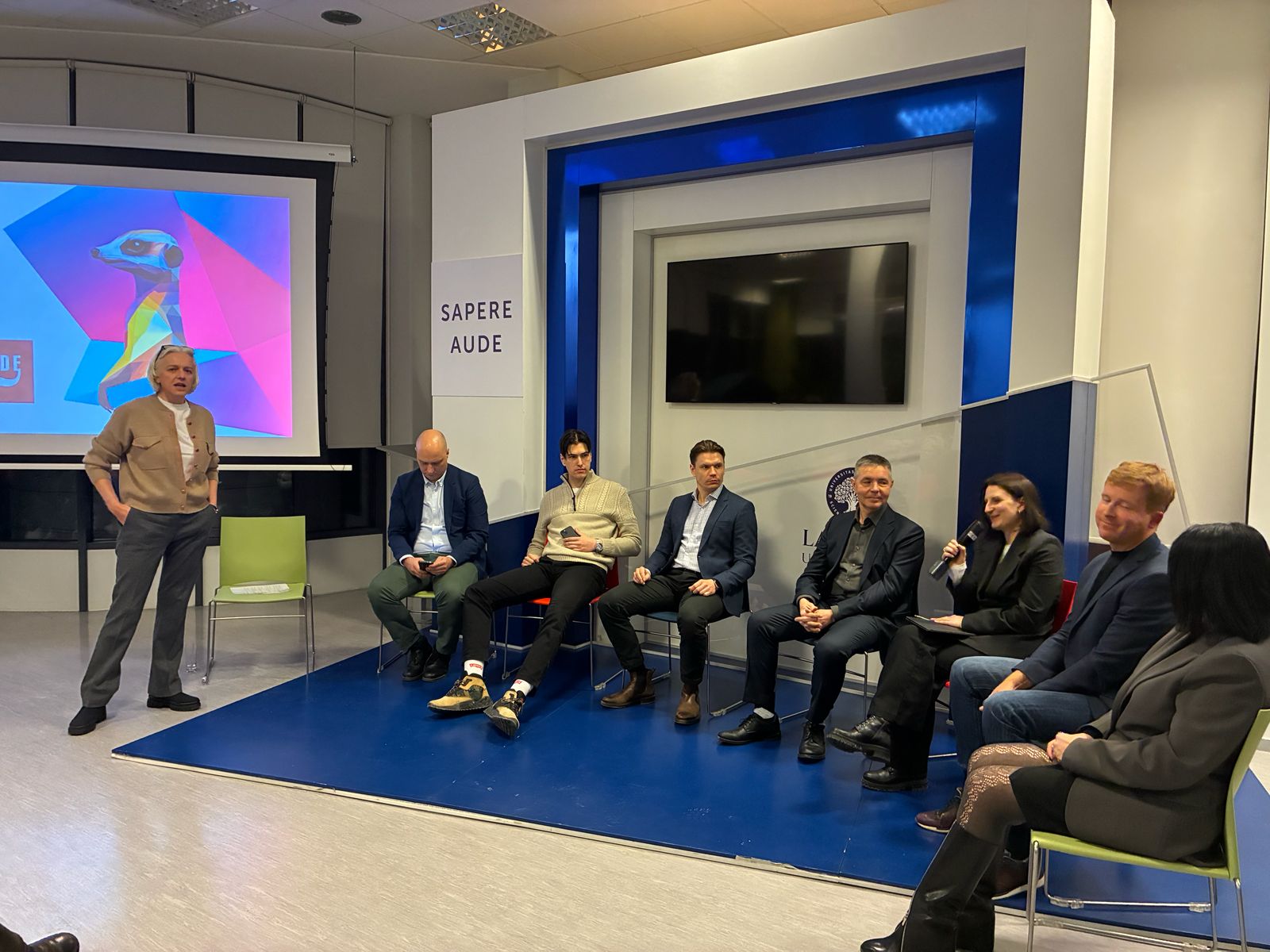
On January 21, 2026, the event “Artificial Intelligence in Education: From Vision to Practical Implementation” took place at the University of Latvia, bringing together education policy makers, representatives of education authorities, academia, and technology companies to discuss the practical implementation of artificial intelligence (AI) in Latvia’s education system.
The event was organized by the University of Latvia Artificial Intelligence Center in cooperation with MILA and TILDE, creating a platform for cross-sector dialogue on the responsible and meaningful use of AI in education.
In the first part of the event, several education technology and AI solutions developed in Latvia were presented, including solutions by MILA members: Ernests’ Method – a digital learning solution for teaching mathematics to students; Orbit8 – a digital career assistant for school career counselors and educators; and Letonika.lv – Letonika School, an AI tool for teachers to create educational chatbots and tests based on their own teaching materials. The presentations demonstrated that Latvian developers are capable of delivering practical, classroom-ready AI solutions that align with the real needs of the education sector.
Ahead of the panel discussion, introductory presentations were delivered by Edijs Freimanis, Senior Expert and National Methodologist for General Education at the State Education Development Agency, and Irina Lučina, Methodologist for Education Technologies and Talent Development at the Ventspils Education Board, outlining the current state of AI adoption at national and municipal levels.
The central highlight of the event was the panel discussion “Artificial Intelligence in Education: From Vision to Practical Implementation,” moderated by Oksana Sivokobiļska, Chair of the MILA Board. The discussion featured Artūrs Vasiļevskis (TILDE), Jana Nerenberga (University of Latvia), Jānis Judrups (AI MasterLab), Edijs Freimanis (State Education Development Agency), Irina Lučina (Ventspils Education Board), Ernests Kazakevičs (Ernests’ Method), and Pauls Irbiņš (Orbit8).
The panelists agreed that the question of whether AI will be used in education is no longer relevant. The key challenge today is to clearly define how and in which educational processes AI can deliver the greatest added value, while ensuring its safe, transparent, and responsible implementation. “Artificial intelligence in education is already a reality. The next step is the ability to collaborate—across government, municipalities, academia, and technology developers—so that AI solutions deliver tangible benefits for students, teachers, and education authorities,” emphasized Oksana Sivokobiļska.
The event highlighted the growing interest in AI applications in education and the need for ongoing dialogue among all stakeholders. The program concluded with an informal networking session, during which participants discussed potential future collaboration projects. The Artificial Intelligence Association of Latvia will continue to actively contribute to discussions and initiatives that promote the safe, practical, and socially responsible implementation of AI in Latvia.